
For many, the daily ritual of tea consists of a frantic dip of a paper bag into a mug of boiling water, followed by a splash of milk to mask the bitterness. But if you have ever wondered why the tea served in a specialized shop tastes distinctly floral, sweet, or malty compared to your home brew, the answer rarely lies in the brand. It lies in the leaf itself.
Making the switch from tea bags to loose leaf is not about snobbery; it is about physics, flavor, and actually saving money. This guide explores the differences and provides the roadmap for upgrading your daily cup.
1. The Anatomy of the leaf: dust versus whole
The primary difference between tea bags and loose leaf is the physical integrity of the tea leaf.
The Tea Bag: “Fannings” and “Dust”
Most commercial tea bags contain “fannings” or “dust”, which are tiny, broken particles of tea leaves. Because these particles are microscopic, they have a massive surface area relative to their volume.
- The result: When hot water hits tea dust, it extracts flavor immediately. Unfortunately, it also instantly releases tannins (the compounds that make your mouth feel dry and bitter). This is why bagged tea often tastes one-note, astringent, and requires sugar or milk to be palatable.
- The constraint: The bag itself restricts water flow. The leaves cannot expand, trapping the infusion inside the paper rather than circulating it through the cup.
Loose leaf: the whole experience
Loose leaf tea consists of whole or partially broken leaves.
- The result: The water needs time to penetrate the leaf. As it unfurls, it releases a complex sequence of flavour compounds: aroma first, then sweetness, and finally body. You get a nuanced cup with depth rather than a punch of bitterness.
- The visual: This expansion is called the “agony of the leaves.” A high-quality rolled Oolong ball can expand to 500% of its dry size, which is why it needs room to move.
2. The economics: is loose leaf expensive?
A common misconception is that loose leaf tea is a luxury item. While the upfront cost of a 100g pouch is higher than a box of 50 bags, the cost per cup is often comparable or lower.
- Re-steeping: This is the secret weapon of loose leaf. A high-quality tea bag is single-use. High-quality loose leaves (especially Oolongs, Puerhs, and Green teas) can be steeped 3 to 5 times. The second steep is often considered the best, as the leaves have fully opened.
- Quality over quantity: You are paying for the leaf, not the packaging, staples, strings, and marketing of the bag.
3. The Essential Toolkit
You do not need a ceramic tea set or a dedicated tea table to start. You only need one specific tool.
- The basket infuser: Avoid the small metal “ball” infusers on a chain. They are too small and cramp the leaves, mimicking the problem of a tea bag. Instead, buy a wide, stainless steel basket infuser that sits deep inside your mug. This allows the water to circulate freely.
- Variable temperature kettle (optional): Nice to have, but a standard kettle works if you simply let the water cool down (see the chart below).
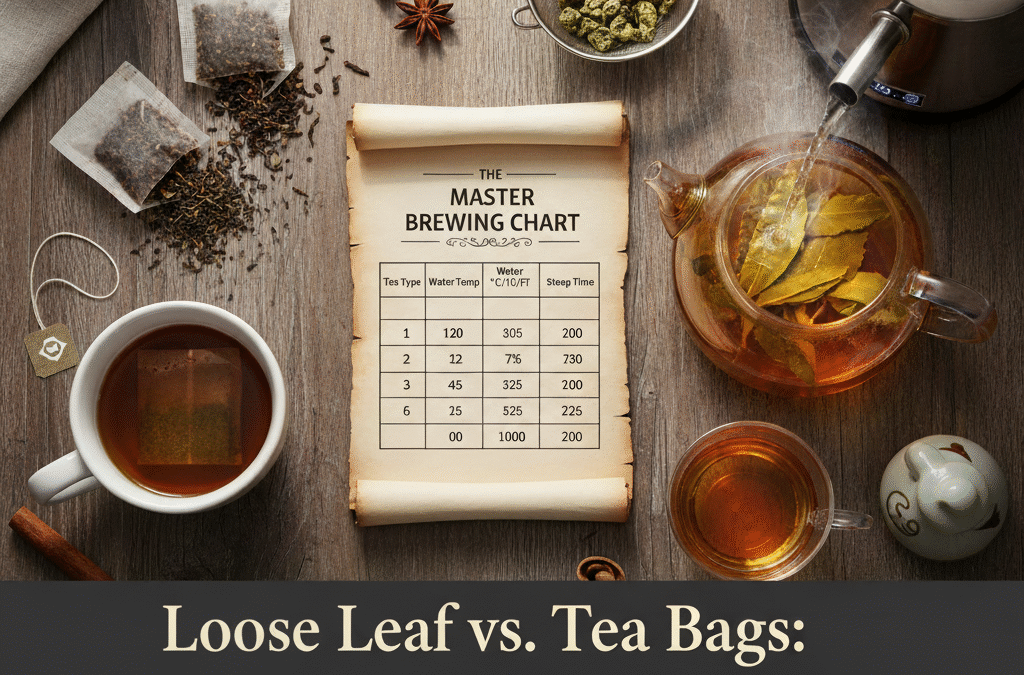
4. The master brewing chart
The most common mistake is burning the tea. Treat tea like cooking pasta; you wouldn’t boil angel hair pasta for 20 minutes. Delicate teas need gentler heat.
| Tea Type | Water Temp (°C) | Water Temp (°F) | Steep Time | Flavor Profile |
| White | 75°C – 80°C | 167°F – 176°F | 2 – 3 mins | Delicate, floral, sweet |
| Green | 80°C | 176°F | 1 – 3 mins | Grassy, vegetal, nutty |
| Oolong | 85°C – 90°C | 185°F – 195°F | 3 – 5 mins | Creamy, floral, roasted |
| Black | 95°C – 100°C | 205°F – 212°F | 3 – 5 mins | Malty, robust, bold |
| Herbal | 100°C | 212°F | 5 – 10 mins | Varies by herb |
Note on cooling water: If you don’t have a fancy kettle, bring water to a boil and open the lid.
- Wait 5 minutes for it to cool to roughly 80°C (Green/White).
- Wait 2 minutes for it to cool to roughly 90°C (Oolong).
5. Step-by-step brewing routine
- Pre-heat your mug: Pour a little boiling water into your mug and swirl it around, then dump it. This ensures your brewing temperature doesn’t drop the second the water hits cold ceramic.
- Measure: A standard rule of thumb is 1 teaspoon (approx. 2-3 grams) of leaves per 8oz cup. For fluffy teas like White tea or Chamomile, use a heaping tablespoon.
- The pour: Place your basket infuser in the mug. Pour the water over the leaves.
- Cover and wait: If your mug has a lid or a small saucer, cover it. This traps the essential oils (aroma) that otherwise evaporate with the steam.
- Decant: Remove the basket infuser at the correct time. Do not squeeze the leaves. Squeezing forces out the bitter tannins you have successfully avoided by brewing correctly.
- Enjoy and save: Set the wet leaves aside. In an hour, you can pour hot water over them again for a second, often sweeter, cup.
Conclusion
Switching to loose leaf tea changes the beverage from a caffeine delivery system into a sensory experience. By controlling the water temperature and allowing the leaves room to breathe, you unlock flavors that simply do not exist in the dust of a paper bag.